Friday

Mike Rohde: SXSW Interactive 2010


While I couldn't attend South by Southwest in Austin, TX this year, I was able to explore the Interactive show through Mike Rohde's handwritten illustrations. Fortunately, I love handwritten type... and I would love to know more about the Interactive world... therefore this hybrid of both get me rather excited.


Rohde brings attention to the lack of focus on typography in web design and questions how a designer can merge the two more often. He suggests freeing one's self from web design samples and doing something so important: seeking OTHER resources. Aside from typography, the lecture Rohde attended focuses on web design itself, mentioning the vitality of designing around a site's content, utilizing grids and systems to control the site, and "going after the details." Most importantly, have FUN designing the website, and make it fun for the viewer. Leave a mark on their brains so they will know to come back to your website.

I think everyone should take notes in illustrative lettering. For everything!

http://www.rohdesign.com/weblog/archives/003166.html

Owltastic

Meagan Fisher, creator of owltastic.com, is a 23-year-old, successful web developer. She has been the Deputy Designer at SimpleBits since August 2008, and a strategic partner at Airbag Industries since January 2009. Skills of hers include Interface design, XHTML and CSS development, speaking and writing about said topics. Her tools to complete these tasks include her 15-inch MacBook Pro, Adobe Photoshop CS3, Adobe Illustrator CS3, Coda by Panic, and iWork '09 Suite. Fisher has created websites for humanitarian purposes--such as change.org and halogennetwork.com--and also personal websites for fellow designers. Her style comes across as clean, simple, and somewhat indie.

I find Meagan to be an inspiration for all the work she has done at such a young age--I also find this to be a complete downer because she's my age and seems to know a lot more about HTML than I do. However, seeing her skills and tools helps me with what I need to know in order to accomplish creating websites myself.

http://owltastic.com/

The Problem with Passwords

Usability researcher Jakob Nielsen’s recent column advocates a fundamental change to password field design on the web. He believes that the time has come “to show most passwords in clear text as users type them,” abandoning the traditional approach that displays a series of asterisks or bullets in place of the actual password.

Nielsen’s controversial proposal demonstrates the principle that most design decisions require trade-offs. User goals and business objectives do not always intersect. Security, usability, and aesthetic concerns often compete. We must set priorities and balance these interests to achieve the best results in each situation.

Security issues are particularly difficult to deal with because they’re an annoyance. We just want to let people get at the great tool we’ve created, but instead we have to build barriers between the user and the application. Users must prove their identities. We can’t trust any data they provide unless it’s been thoroughly sanitized.

Unfortunately, this is reality. A great deal of web traffic really is malicious, and sensitive data gets stolen. Typically, we ask users to supply a username (often an e-mail address) along with a password to sign in to an application. The username identifies the person, while the password proves that the person submitting the username is indeed the one who created the account. That’s the theory, based on two assumptions:

A password will never be visible outside the mind of the person who created it.
Both the username and password can be recalled from memory when needed.
This approach places a significant cognitive burden on people who use websites that require authentication. In general, we get by remarkably well, but it’s easy to see the weaknesses in the system. Passwords that are easy to remember are also easy to guess. When people are forced to choose strong passwords, they’re more likely to either write them down or forget them. The usual response is a password reset mechanism, which naturally undermines the strength of the entire system. It doesn’t matter that my password is encrypted with the strongest ciphers known to man when it can simply be reset by anyone who knows which high school I attended.

This is one of the reasons that Nielsen suggests abandoning password masking. People get frustrated and often reset passwords that they haven’t actually forgotten simply because they’ve mistyped. Providing clear feedback with unobscured letters will reduce errors, improve the user experience, and lessen the need for insecure alternatives.

However, making such a sweeping change to a fundamental user interaction could present serious problems. Consider some contexts in which a password might need to be entered in front of a large group of people, such as while using a conference room projector. And many years of web experience have set user expectations on how form elements should work. People understood that password masking was invented for their security. Failing to meet that expectation might undermine confidence, and we cannot afford to lose our users’ trust.

Proceed with caution
When dealing with such a fundamental area of the web experience, we need to be careful because we’re dealing with deeply conditioned expectations. The username/password method of securing web applications isn’t perfect, but there are few good alternatives and it’s become the standard approach. We can best address the usability concerns of password fields by testing incremental changes like these to extend default behavior—without compromising the basic experience and losing the trust of our users.

http://www.alistapart.com/articles/the-problem-with-passwords/

Paul Debevec


http://www.ted.com/talks/paul_debevec_animates_a_photo_real_digital_face.html

WEBBIES! : Twitter


Biz Stone, co-founder of Twitter, has been named winner of the Webby Award for Breakout of the Year. He is rewarded for his incredibly innovative creation of the "micro-messaging" establishment. Within its three short years of existance, Twitter has grown by a miraculous 900% in solely the last year. From celebrities to average Joes, President Obama to worldwide corporations, most people who own a computer in the world have jumped onto the Twitter bandwagon. With 140 characters or less, Stone has evolved the internet into something completely different. "This is the ultimate embodiment of the democratic spirit of the Web."

http://www.webbyawards.com/webbys/specialachievement13.php/#reznor

Katarina Jerinic

Katarina Jerinic, a renowned artist in the Interactive industry, digitally creates maps, systematic compositions, and similar established "navigational guides." In order to do so, Jerinic studies "formal models of natural phenomena," investigating the details of that which organically exist. The artist then takes these landscapes and poses them to be fictional, recreating them with her own personal designs. "I am interested in using the structure of one to examine the other--not unlike the Situationist tactic of using a map of one place to move through another." Jerinic essentially is reacting to the natural space around her, and furthermore attempting to get others to react within the spaces she creates herself.

Katarina Jerinic participated in the Bronx Museum’s AIM program and has completed residencies at MacDowell Colony and the Experimental Television Center. She is currently an artist-in-residence at the Center for Book Arts, New York. She has an MFA from School of Visual Arts. Her work has been recently included in exhibitions at NurtureArt, Rotunda Gallery, the Brooklyn Arts Council Gallery, DUMBO Art Under the Bridge Festival, all in Brooklyn, NY; the Bronx Museum of the Arts, Bronx, NY; Queens Museum of Art, Queens, NY; the Fox Art Gallery, University of Pennsylvania, Philadelphia, PA; Gallery Aferro, Newark, NJ; the Center for Book Arts, New York, NY; and Mills Gallery at Boston Center for the Arts, Boston, MA. Her collaborative project with Naomi Miller, The Work Office (TWO), has been awarded grants from the Black Rock Arts Foundation, the Brooklyn Arts Council, chashama, and LMCC Swing Space.


http://ps1.org/studio-visit/artist/katarina-jerinic

NOISEnotNOISE


A two-day symposium entitled "Noise Not Noise," presented by Western Front Society's Exhibitions and New Music Department, is currently being displayed in the New Museum of Vancouver. To coincide with this event, the Western Front Society's Executive Director, Caitlin Jones, has curated an online exhibit, also entitled NoiseNOTNoise. Different aspects of noise will be explored in this event, including the evolving role of noise, specifically in our age of the overwhelming changes within the digital and technological world. NoiseNOTNoise takes on the subject of information overload and attempts to define the "noise" we are being fed from networking websites such as Twitter, Facebook, and YouTube. I recently read how many ads, loads of useless information, and bits of important news that we take in within a day, and the numbers are incredible. It's interesting to see an artist take this subject on in the manner of installation.

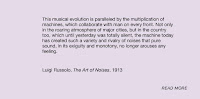
Russolo, a Futurist painter and composer is considered to be a progenitor of “noise” as a cultural form. Futurism, and by extension “noise” as a genre, are often discussed in an industrial context – born out of the machinations of the industrial revolution. The digital revolution has given rise to another form of noise: data which flows through networks at an almost inconceivable rate. In this shift from industrial to informational, the assaultive or dissonant form of noise is diminished; instead, noise is manifested as the monotonous and banal forms to which Russolo refers.

Twitter publicizes that approximately 500 million tweets a day are posted, and YouTube brags that 20 hours of footage is uploaded per minute. Add to that the myriad of blog posts, Facebook updates and other social networking sites that pump news, personal information and images into the ether, and the result is an unimaginable accumulation of digital sediment. Sometimes generated consciously and other times as a by-product of our lives lived online, a generation of artists are sifting through this digital flow and making undetectable digital noise much “noisier.”

This exhibition is presented as part of a larger series of panels and performances exploring the changing role of noise in culture. The two-day symposium Noise not Noise will examine new realms for new realms for noise making and its broader meanings and interpretations across disciplines.


http://rhizome.org/editorial/3399